Fusion diagrams
Anyon fusion and splitting, fusion trees, and the F and R moves of a fusion category, drawn in plain TikZ with the equations as LaTeX.
- fusion category
- anyons
- topological quantum computation
- F-move
- R-move
Examples
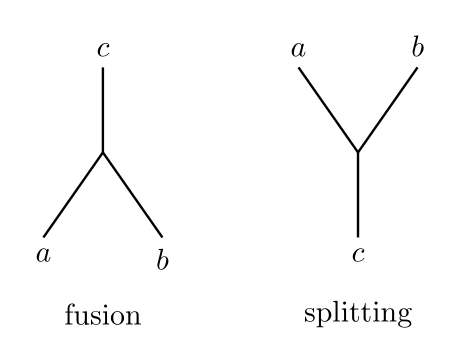
Fusion and splitting vertices
Two anyons a and b fusing into c, and c splitting into a and b.
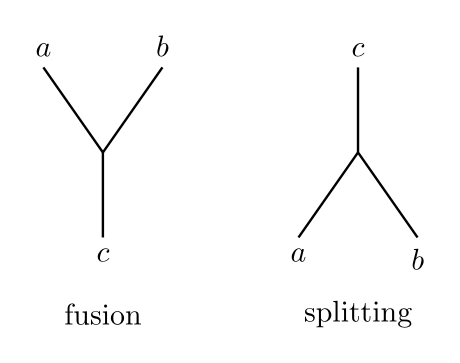
Fusion and splitting vertices, time going down
The same two vertices read from top to bottom: a and b fuse into c below them, and c splits into a and b.
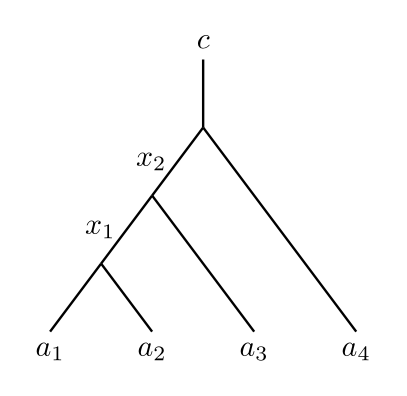
Fusion tree basis
Four anyons fused left to right through the intermediate charges x₁ and x₂ to a total charge c.
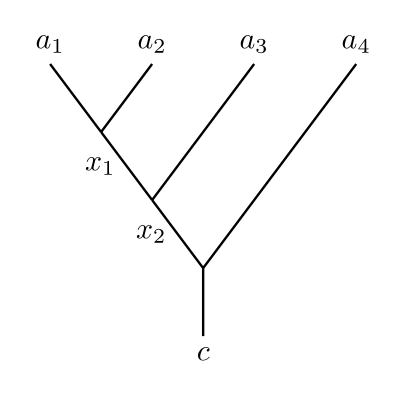
Fusion tree basis, time going down
Four anyons entering at the top and fused left to right through the intermediate charges x₁ and x₂ to a total charge c below.
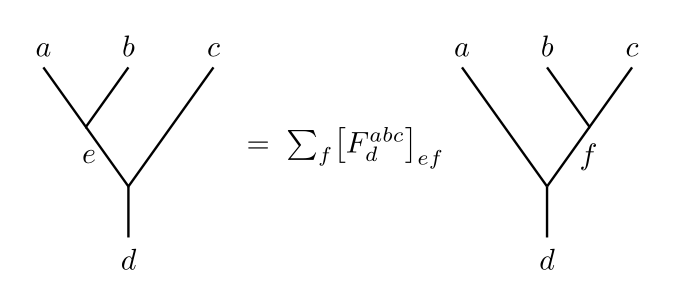
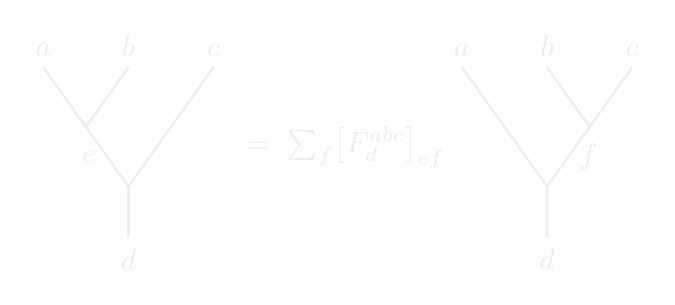
F-move
The charge d splits into a, b, and c in two bracketings; the change of basis between them is the F-matrix, [F^{abc}_d]_{ef}.
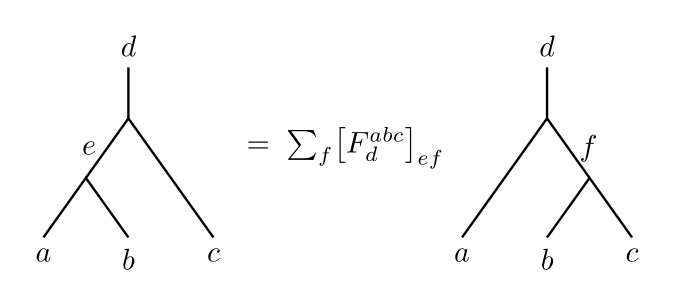
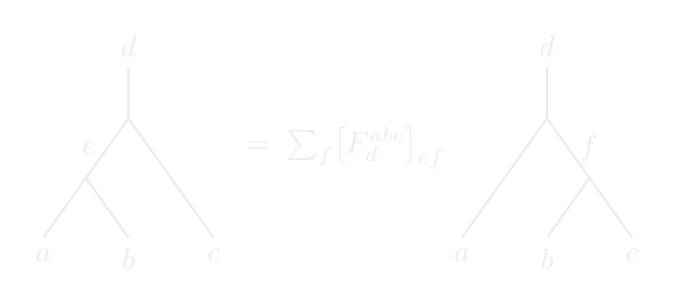
F-move, time going down
The same F-move read from top to bottom: d at the top splits into a, b, and c below, with the same coefficient [F^{abc}_d]_{ef}.
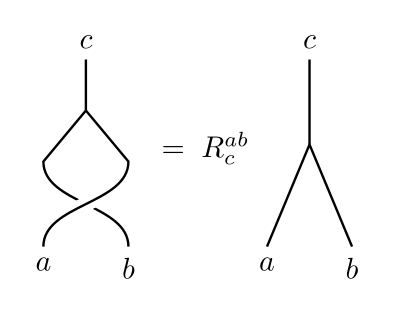
R-move
Exchanging two anyons before they fuse multiplies the vertex by the phase R.
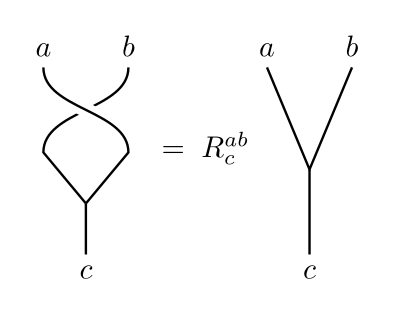
R-move, time going down
The same R-move read from top to bottom: a and b enter at the top, a crosses in front of b, and they fuse into c below.
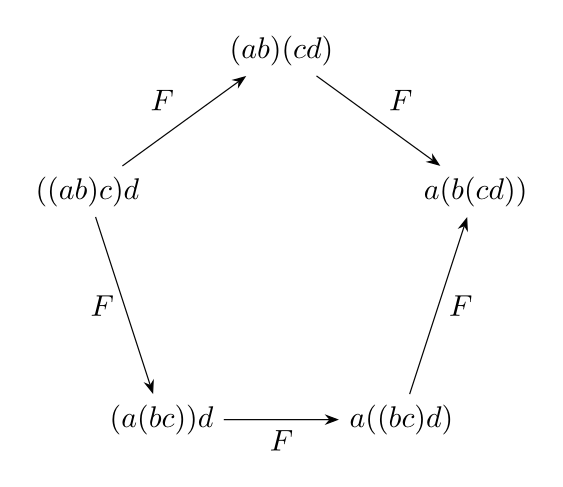
Pentagon equation
The five bracketings of four objects on a regular pentagon, joined by the associator F: both routes from ((ab)c)d to a(b(cd)) agree.
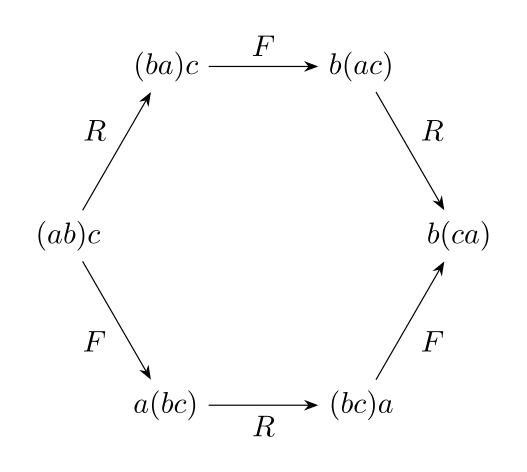
Hexagon equation
Moving a past b and c on a regular hexagon: braiding with bc at once (R) agrees with braiding past b and then c, with associators F between.
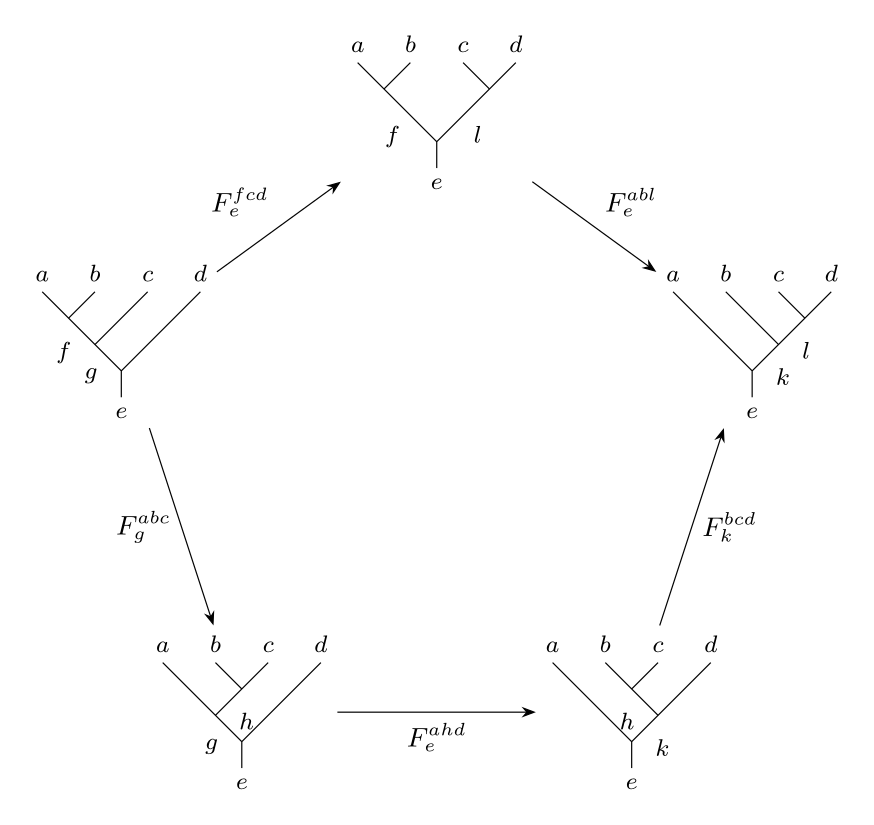
Pentagon equation with fusion trees
The five splitting trees of four anyons with total charge e on a regular pentagon, joined by F-moves; the arrows carry the F-symbols whose product is the same along both routes.
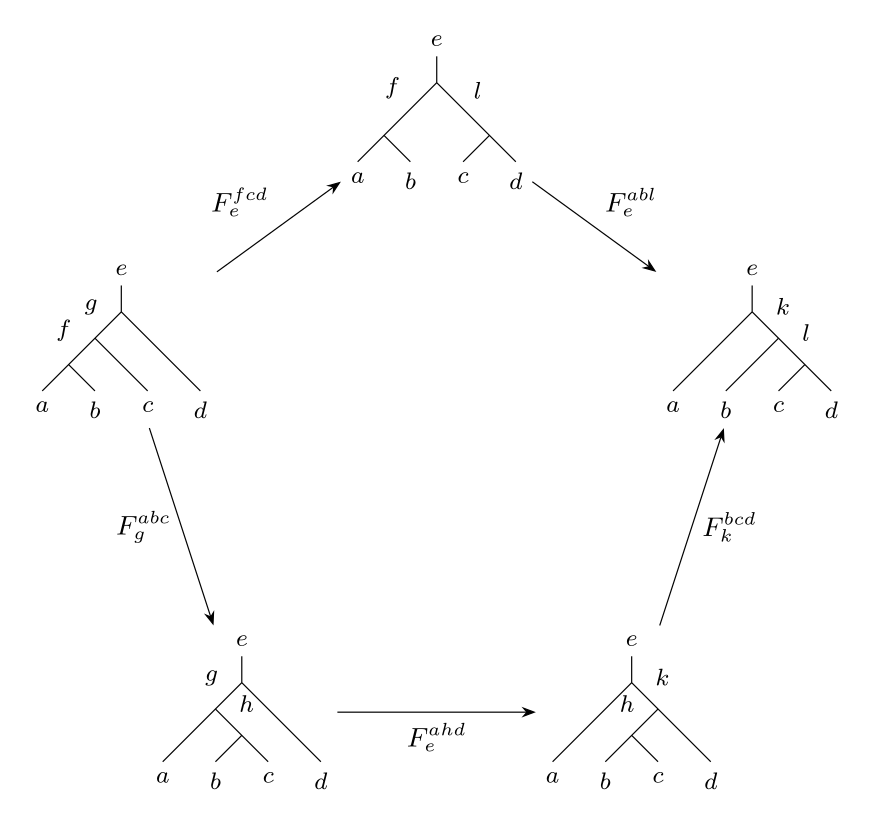
Pentagon equation with fusion trees, time going down
The same pentagon read from top to bottom: each tree is reflected, so e sits at the top, and the F-symbols are unchanged.
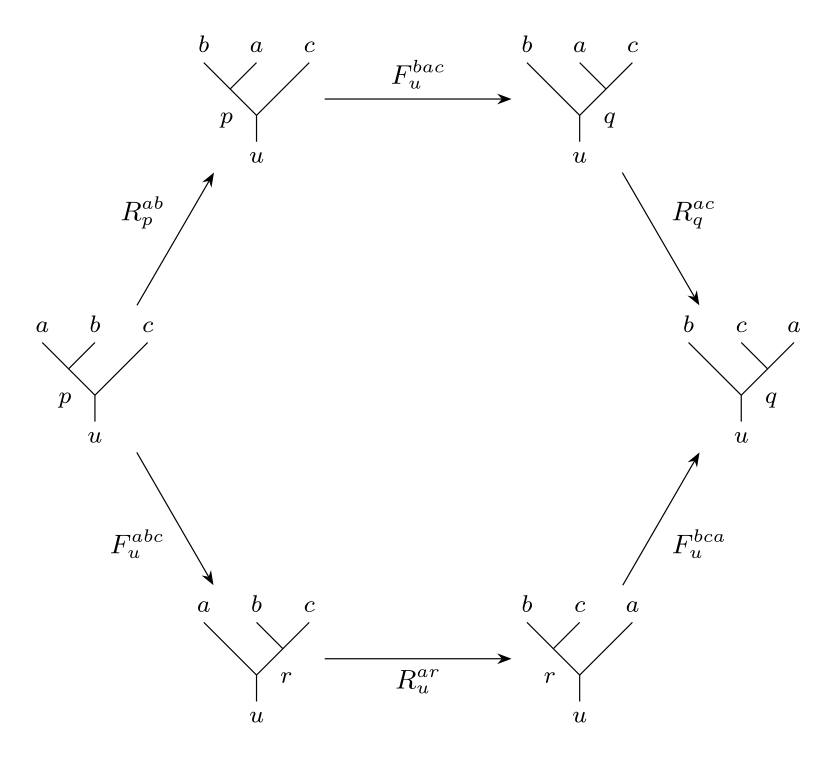
Hexagon equation with fusion trees
The splitting trees of a, b, and c with total charge u on a regular hexagon, as a moves past b and c; the edges p, q, and r are named as in Kitaev's paper.